
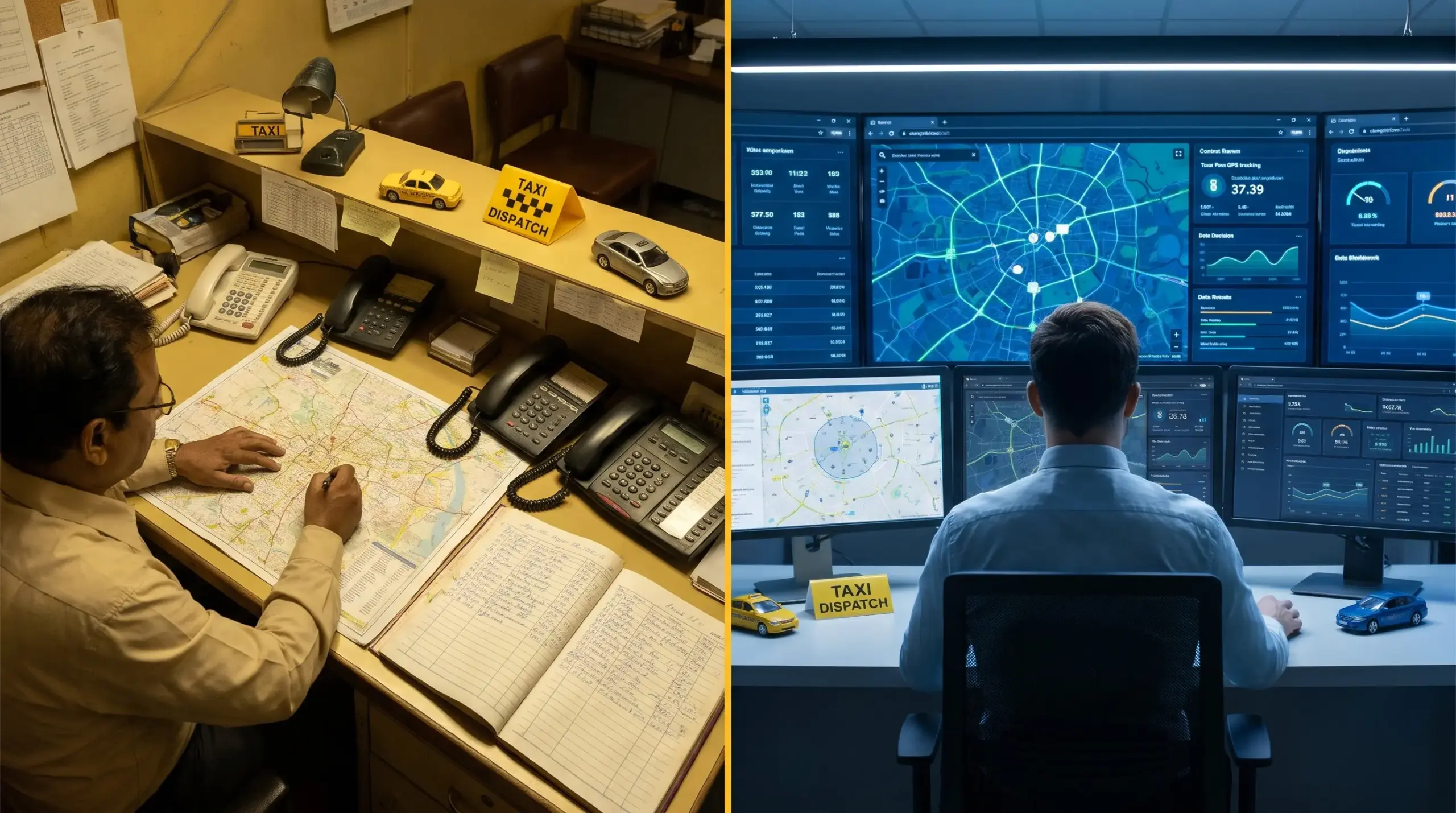

There are two dispatch centres in the same city and on the same night. At one of them, the phone rings continuously and a marker scratches across a whiteboard which has already been partly smudged by previous alterations. At the other, the screen slowly reassigns drivers as new bookings are received, with very few people using a keyboard. Both centres aim to carry out the same task: getting the correct car to the right passenger as quickly as possible.
The approaches taken to achieve that task manual dispatch as opposed to automated dispatch could not be more different, and the difference between them is evident in areas such as response times and the amount that the fleet spends on its day-to-day operations. For growing fleets, choosing between manual vs automated dispatch also means deciding whether a taxi dispatch system can manage bookings, driver availability, and vehicle assignments efficiently as demand increases.
What Manual Dispatch Actually Involves?
Manual dispatch involves a person or a small group of people keeping track of where the vehicles are, of the drivers’ availability, and of the new bookings, after which they make the assignments in real time using their memory, information from radio check-ins, and any notes that are on a board or spreadsheet. The system used to function adequately for many decades when the fleets were small, and demand was more steady, but it completely depends on the skill and the ability to cope of the person in charge. When it’s a quiet afternoon, a competent dispatcher can manage all the tasks with little effort; but during a Friday night rush or in the case of a sudden weather event, the same system which seemed manageable an hour before can break down rapidly.
What Automated Dispatch Actually Involves?
The automated dispatch software keeps continuous track of the position of each vehicle using GPS, automatically matches arriving bookings to the closest or most appropriate driver that is available, and makes real-time updates to the assignment whenever the situation changes. An automated taxi dispatch system helps taxi operators coordinate bookings, track driver availability, and assign trips without relying entirely on manual communication. Rather than having to keep track of the whole fleet in their mind, the dispatcher is freed from that task and can instead focus on dealing with exceptions and customer service problems rather than carrying out routine matchings. Since the software never gets tired, distracted, or overwhelmed during a busy shift as a person eventually does, this is the reason why the performance difference between the two methods tends to increase as the volume of work goes up.
Manual vs Automated Dispatch: How the Two Approaches Compare?
Speed and Response Time:
The speed at which manual dispatches are carried out depends on the number of bookings that a dispatcher has to handle; response times tend to become longer during busy periods, exactly when customers matter most in terms of getting a quick pickup. With automated dispatch, the nearest available driver is assigned within seconds no matter what the total number of bookings is, since the system is not restricted by how quickly one person can process requests.
Accuracy and Error Rates:
A manual system is susceptible to human error, such as making two bookings of the same event, forgetting to assign a task, or giving a driver the wrong address because of mishearing over the radio. Automated systems obtain the address and location information directly from the booking, thus eliminating most of the transcription and memory errors involved in manual coordination.
Cost Structure:
The cost of using manual dispatch is mainly determined by the number of people employed, requiring additional dispatchers for more shifts and greater coverage as the business grows. In contrast, automated dispatch software usually involves a fixed monthly fee per vehicle and becomes more cost-effective as the fleet increases beyond what one or two dispatchers can reasonably handle on their own. There is also an unseen cost associated with manual dispatch that doesn’t appear on the payroll: lost bookings, vehicles that sit idle, and customers who become frustrated and simply stop calling back, all of which slowly reduce revenue in a manner that a monthly software subscription does not. For taxi operators handling increasing booking volumes, taxi dispatch software can help reduce repetitive coordination work and improve the use of available vehicles.
Scalability:
A manual system that works well with eight vehicles usually begins to fail when dealing with fifteen or twenty vehicles, simply because a single dispatcher cannot reliably keep track of that many moving items without errors appearing. Automated systems are able to cope with much larger fleets without needing a corresponding increase in the number of staff, since the software carries out the tracking regardless of how big the fleet is.
Data and Reporting:
The data produced by manual dispatch is very limited to what has been written down, so it’s difficult to identify trends such as which areas are underserved or which shifts have the highest number of cancellations. On the other hand, automated dispatch systems produce detailed records automatically and thus provide owners with the kind of reporting necessary for making data-driven decisions regarding scheduling, pricing, and fleet allocation.
Where Manual Dispatch Still Has a Place?
Small operations, involving only a few vehicles and having a steady, predictable number of customers, can often manage adequately with manual dispatch, especially when the owner acts as the dispatcher and knows each driver and regular customer personally. For fleets of this scale, the cost of introducing automated software is not usually worth it at the moment, although most owners eventually come to regard the move as worthwhile when the fleet has grown beyond the point at which personal memory is sufficient.
Bonus Read: How Automated Driver Assignment Improves Taxi Dispatch Systems?
Where Automated Dispatch Clearly Wins?
When a fleet reaches about ten or fifteen vehicles in size, or when it begins to operate several shifts in order to cover long hours, it becomes hard to oppose the idea of having automated dispatch. In the first few months of using it, the advantages of faster response times, fewer errors, better data, and more predictable costs usually overcome the trouble of making the change, particularly if the fleet is already losing bookings because of slow response times or dispatch mistakes. Choosing the right taxi dispatch software also gives growing businesses a more organized way to manage bookings across multiple shifts.
The Transition Doesn’t Have to Be All or Nothing?
A number of fleets adopt automated dispatch by temporarily combining it with manual methods for a brief time, allowing both dispatchers and drivers to get used to the changes before completely abandoning the previous system. Since this step-by-step approach helps minimize opposition from staff who are used to the old method, it at the same time brings the fleet closer to the efficiency benefits that automation provides. A dispatcher who at first fears that the software will take their job usually ends up finding that this does not happen, instead spending less time on repetitive matching and more time on the types of problems that really require a human judgment call.
About UnicoTaxi:
The automated dispatch system of UnicoTaxi instantly matches bookings with the closest available driver, keeps track of all the vehicles in the fleet, and produces the reports that enable owners to see precisely where manual procedures had earlier caused bottlenecks. As an automated taxi dispatch system, UnicoTaxi helps operators coordinate bookings, monitor fleet activity, and manage driver assignments through a centralized platform. Taxi dispatch software such as UnicoTaxi can support this transition by bringing routine dispatch activities into one system.
Final Thoughts:
It’s not really a matter of deciding which method is manual or automated is inherently the better one in all circumstances; rather, it’s about choosing the approach that matches the size of the fleet, its plans for growth, and the level of tolerance it has for the inefficiencies inherent in human-managed coordination. Although small and stable operations can perhaps still do with just a whiteboard and a radio for the time being, any fleet that grows beyond the point where one person can reliably keep track of all the vehicles will soon find that automated dispatch pays for itself thanks to quicker response times, fewer mistakes, and data that actually helps in running the business more effectively.
If you’d like to know how automated dispatch could benefit your fleet, why not get in touch with UnicoTaxi to arrange a free demonstration and see the difference for yourself?
Frequently Asked Questions:
- Is it worthwhile to automate dispatch for a small taxi fleet?
It all comes down to the size of the fleet and their plans for growth. Although very small and stable operations might be able to get by with manual dispatch for the moment, most fleets discover that automated dispatch proves worthwhile when they grow beyond the capacity that a single dispatcher can reliably handle.
- What is the main benefit of having an automated dispatch system rather than a manual dispatch system?
The improvements in speed and accuracy are usually the most obvious ones, since automated systems are able to match each booking with the closest driver within a few seconds and obtain the location information directly from the booking instead of having to depend on manual communication. This taxi dispatch system also helps improve booking coordination during busy periods.
- Does automated dispatch mean you have to replace all staff?
No, the dispatch staff usually move on from carrying out routine matching tasks to dealing with exceptions, customer service, and problems that the software is unable to resolve on its own, rather than being completely eliminated.
- What is the typical cost of automated dispatch software when compared with manual dispatch?
With automated dispatch, the cost is typically a fixed amount on a monthly basis per vehicle, whereas with manual dispatch the cost rises in accordance with staffing requirements, which is why automation tends to be more cost-effective as the fleet increases.
- Is it possible for a fleet to make a gradual transition to automated dispatch?
Yes, a great many fleets carry out automated dispatch together with manual procedures for a brief adjustment period, thus helping the staff through the transition before making the full switch.